Overview
What Is Experience Certificate Attestation?
Experience certificate attestation is the official process by which an employment or work-experience certificate is verified and authenticated by a chain of designated government authorities — from state-level departments all the way to the relevant foreign embassy. The attested seal and signature confirm that the document is genuine, legally valid, and issued by an accredited organization.
Whether you are travelling to the UAE, Saudi Arabia, Qatar, Kuwait, Oman, Bahrain, or any other GCC country for employment purposes, most employers and immigration authorities require your experience certificate to be properly attested before it can be accepted. Without valid attestation, your documents may be rejected, delaying or jeopardizing your overseas career plans.
Why Is Employment Certificate Attestation Required?
Foreign governments and employers need assurance that the experience certificate you present is authentic and not forged. Attestation by authorized Indian government bodies — followed by the relevant embassy — provides this legal guarantee. It is mandatory for:
- Employment visa applications for UAE, Saudi Arabia, Qatar, Kuwait, Oman & Bahrain
- Residence and work permit renewals in the Gulf Cooperation Council (GCC) countries
- Higher education admissions abroad that require proof of professional experience
- Professional licensing with overseas regulatory authorities (e.g., DHA, MOH UAE)
- Immigration and permanent residency applications in various countries
Document Types
Categories of Documents Requiring Attestation
Before beginning attestation, it is important to understand how your document is classified. Indian authorities follow a three-category classification, and each category follows a distinct attestation pathway:
Non-Educational Documents
Experience certificates, employment letters, date of birth/death certificates, marriage certificates, affidavits, and driving licences. These are first attested by the State Home Department of the issuing State/UT.
Educational Documents
Degrees, diplomas, and academic certificates. First attested by the State Education Department (HRD) of the concerned State Government/Union Territory.
Commercial Documents
Business and trade documents. Pre-authenticated by the respective State Chamber of Commerce before MEA legalization. Each document must carry the authorized signatory's name, designation, and rubber stamp.
The Process
Step-by-Step Experience Certificate Attestation Process
The attestation process follows a mandatory sequence. Skipping or reversing any step will result in rejection. Here is the complete certified process:
1
Notary Attestation
Your experience certificate is first verified and attested by a registered Notary Public. This is a prerequisite for all subsequent government-level attestations.
2
State Home Department Attestation
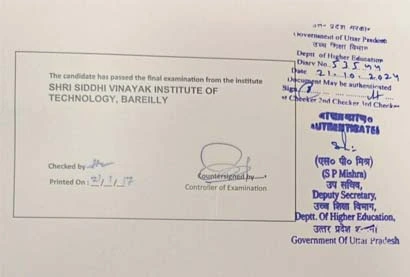
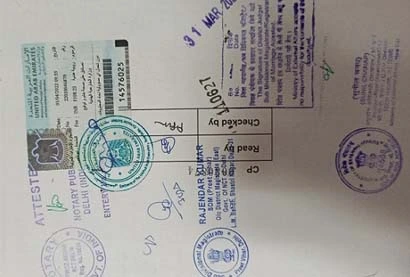
Non-educational documents such as experience certificates are submitted to the State Home Department (or the State General Administration Department) of the state in which the document was issued. Attestation here is stamped with the name, designation, and official seal of the authenticating authority.
3
MEA Attestation (Ministry of External Affairs)
After successful state-level attestation, the document is submitted to the Ministry of External Affairs (MEA), New Delhi for legalization. The MEA verifies the signature and seal of the State authority and provides its own stamp/apostille. Note: MEA does not verify the content of the document — that responsibility rests with the state authorities.
4
Embassy / Consulate Attestation
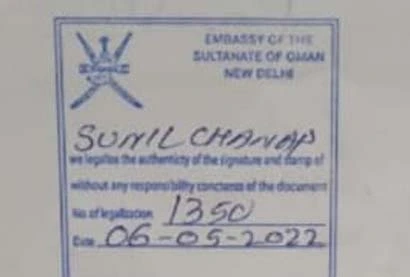
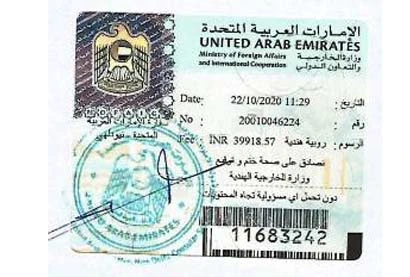
Once MEA attestation is complete, the document is submitted to the concerned foreign embassy in India (UAE, Saudi Arabia, Qatar, Kuwait, Oman, Bahrain, etc.). The embassy verifies the MEA stamp and provides its final attestation, making the document legally valid for use in the destination country.
5
MOFA Attestation (Destination Country)
Some countries — particularly Saudi Arabia and Kuwait — also require attestation from their own Ministry of Foreign Affairs (MOFA) after the embassy in India has attested the documents. Trust Attestation can coordinate this step as well.
Requirements
Documents Required for Experience Certificate Attestation
Prepare the following documents before initiating the attestation process. Submitting incomplete paperwork is the most common cause of delays:
- Original experience or employment certificate (to be attested)
- One clear photocopy of the experience certificate
- Clear photocopy of the applicant's valid passport (first and last pages)
- Passport-size photograph of the applicant
- Job offer letter / employment contract (if attesting for immediate use)
- Authorization letter (Affidavit on Rs. 10 stamp paper) — required for Saudi Embassy attestation
Saudi Arabia
Experience Certificate Attestation for Saudi Arabia
Saudi Arabia has one of the most thorough attestation procedures for employment documents. After HRD (if applicable) and MEA attestation are completed in India, the documents must be submitted to the Saudi Cultural Attaché Office, Royal Embassy of Saudi Arabia, New Delhi.
Key Points for Saudi Embassy Attestation
Documents for the Saudi Embassy must be submitted through an authorized travel agency. Submission is accepted only from Monday to Wednesday, and the entire process typically takes between 10 to 45 working days, depending on university verification and embassy workload.
The Saudi Embassy sends a photocopy of educational certificates to the issuing institution for verification. This university verification alone can take a week or more. To accelerate this, applicants are advised to personally follow up with their institution's examination department.
Eligibility Requirements
- Applicant must have a valid job offer letter from a Saudi employer (government or private sector)
- Private sector job offers must be attested by the Saudi Chamber of Commerce and Saudi MOFA
- Government sector jobs require an official stamped copy of the job offer
- The authorized agency must carry a valid ID card and rubber stamp issued by Saudi Embassy New Delhi
- All degrees must be attested by: State Higher Education Department → MHRD → MEA (in that order)
Final Documents Required at Saudi Embassy Submission
- Original experience / degree certificate
- Offer letter — original + Chamber of Commerce + MOFA seal with date
- Passport copy — clear and current
- Iqama copy in colour (if already working in Saudi Arabia)
- Issued visa copy
- Authorization letter / Affidavit on Rs. 10 stamp paper
Once embassy attestation is complete, all attested documents are returned to the authorized agency. Every submission is entered into the Saudi Embassy's official database, and photocopies are preserved for future verification.
Apostille
Apostille vs. Embassy Attestation for Experience Certificates
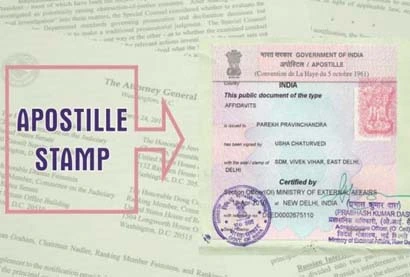
An Apostille is an internationally recognized certificate issued by the MEA under the Hague Convention. It is accepted by all 120+ Hague Convention member countries without requiring further embassy attestation. If your destination country is a Hague Convention signatory, an apostille stamp on your experience certificate is sufficient.
However, GCC countries such as the UAE, Saudi Arabia, Qatar, Kuwait, Oman, and Bahrain are not Hague Convention members. For these destinations, a full Embassy Attestation process — including MEA stamp followed by embassy attestation — is mandatory.
Not sure which process applies to you? Contact our team for a free consultation →